
Meta Description: Gemini 3.5 Pro has missed multiple release deadlines in 2026. Here’s why Google keeps delaying it, and how Claude, GPT, and open-weight models like Kimi K3 are filling the gap.
Focus Keyword: Gemini 3.5 Pro delay
Secondary Keywords: Google Gemini 2026, AI model race, open weight AI models, Kimi K3, DeepSeek V4, frontier AI models 2026
Why Gemini 3.5 Pro Keeps Getting Delayed — And Who’s Winning While Google Waits
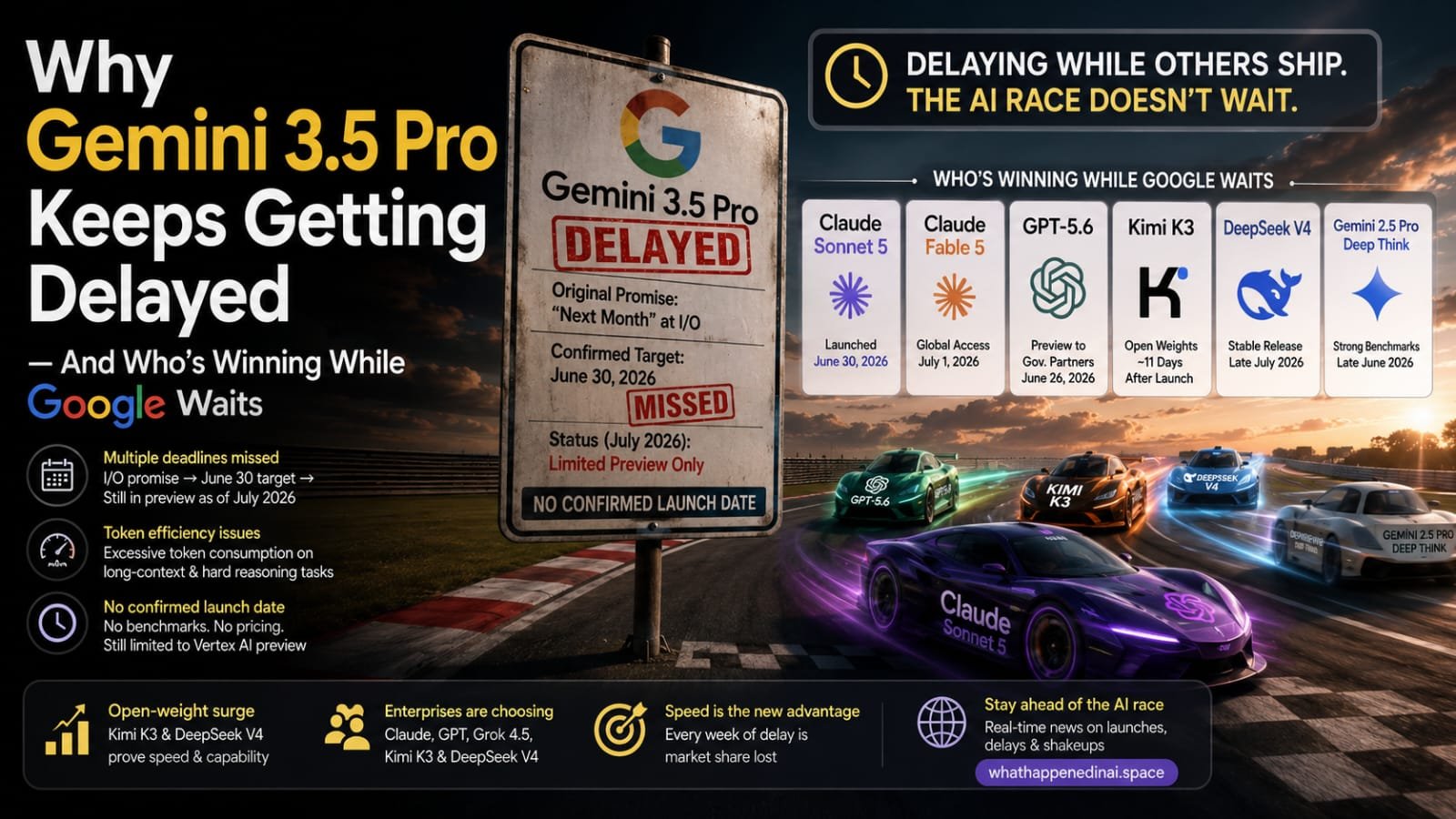
Google has a release-date problem, and by this point in 2026, it’s hard to ignore. Gemini 3.5 Pro was originally teased at I/O with a “give us until next month” promise. Then a confirmed June 30 general-availability target came and went. As of late July, it’s still sitting in limited Vertex AI enterprise preview, with no confirmed launch date, no published benchmarks, and no announced pricing.
For a company that effectively kickstarted the modern AI era through its own foundational research, watching Google fall behind on its own announced timeline is one of the stranger storylines of the year. This piece digs into what’s actually causing the delay, who has capitalized on the gap, and what it says about how the AI industry’s competitive rhythm has changed.
A Timeline of Broken Promises
It helps to lay out exactly how this unfolded, because the pattern of missed deadlines is itself part of the story. At I/O, Google signaled Gemini 3.5 Pro was close, essentially asking developers to wait “one more month.” That soft deadline passed without a launch. Alphabet then confirmed a firmer June 30 general-availability target. That date also passed, with the model still confined to a limited enterprise preview inside Vertex AI.
By early July, reporting confirmed the model had missed both of those self-imposed deadlines, and by mid-to-late July, it remained in preview with no fresh date attached. Two consecutive missed deadlines is a very different story than one slip. One delay is normal in software development — plans change, testing reveals issues, nobody bats an eye. Two consecutive misses on a headline product, especially from a company with Google’s resources, starts to look like a genuine internal struggle rather than ordinary caution.
What’s Actually Causing the Delay
Google’s official explanation centers on incorporating feedback from early testers, specifically around excessive token consumption during long-context and hard reasoning tasks. In plainer terms: the model was reportedly using more tokens than expected to arrive at a good answer, which affects both cost and speed for anyone running it at scale.
That’s not a trivial thing to fix quietly. Token efficiency isn’t a UI tweak — it touches how the model reasons internally, which means Google is likely doing substantive retraining or architecture-level work rather than just polishing a launch page before flipping a switch. It also suggests the earlier “next month” promises were made before that inefficiency was fully understood or measured, which is its own lesson in why AI companies should be cautious with public deadlines they haven’t stress-tested against real enterprise workloads.
There’s a reasonable version of events here that isn’t damning: better to delay and fix a token-efficiency problem than ship a model that becomes notorious for burning through customer budgets on simple tasks. Enterprise buyers remember cost surprises for a long time, and Google presumably knows that reputational risk cuts both ways.
Meanwhile, Everyone Else Kept Shipping
The frustrating part for Google, and the interesting part for everyone watching the industry, is that the rest of the field didn’t wait around. In the same window Gemini 3.5 Pro has been stuck in preview, competitors have landed major releases:
- Claude Sonnet 5 from Anthropic, focused on long-run agentic coding and debugging, launched June 30 — the very date Gemini 3.5 Pro was supposed to hit general availability.
- Claude Fable 5, restored to global access on July 1 after a brief export-control-related suspension earlier in the year.
- GPT-5.6, previewed to government-vetted partners on June 26 as OpenAI’s next frontier step, even if not yet broadly available.
- Kimi K3 from Moonshot AI, with open weights promised within about eleven days of its mid-July API launch.
- DeepSeek V4, which shipped a stable release in the same stretch, in late July.
- Gemini 2.5 Pro with Deep Think, notably a separate model from the delayed 3.5 Pro, which delivered positive benchmark news of its own in late June.
That final week of July alone represents one of the largest concentrations of open-weight model releases the industry has seen. Google not only missed its own deadline twice, it missed it during the exact window when open-weight competitors were proving they can move just as fast as the closed labs — sometimes faster.
Why the Open-Weight Surge Matters More Than It Looks
It’s easy to treat every model launch as just another entry on a leaderboard, but the open-weight angle here is genuinely significant, and it deserves more attention than it usually gets in mainstream coverage. When Kimi K3 and DeepSeek V4 ship competitive, openly available weights within days of each other, it changes the calculus for smaller companies and independent developers who can’t afford frontier-model API bills at scale, or who have data-sovereignty requirements that rule out sending information to a third-party API entirely.
Open weights also mean researchers and smaller labs can inspect, fine-tune, and build directly on top of these models without negotiating enterprise contracts. That’s a fundamentally different distribution model than the closed, API-gated approach that OpenAI, Google, and Anthropic have generally favored. It puts real pressure on the closed labs to justify why their pricing and access restrictions are worth the premium, especially as the capability gap between open and closed models continues narrowing.
For enterprises deciding which model to build on this quarter, that pressure is already visible in procurement conversations: teams are now actively choosing between GPT-5.6, Claude, Grok 4.5, and Kimi K3, and every week that Gemini 3.5 Pro stays absent from that shortlist is a week those contracts get signed with someone else. Enterprise software contracts often run a year or more; losing this particular window isn’t just a bad news cycle for Google, it could mean losing customers for the full length of a contract term.
Is This a Google Problem or an Industry-Wide Signal?
A little of both. Google has real advantages — massive infrastructure, deep research talent, and Gemini 2.5 Pro with Deep Think already delivering solid benchmark results in a separate model family that shipped without the same drama. So this isn’t a company that’s lost its footing entirely, nor is Gemini as a brand suddenly irrelevant. It’s a company that overpromised a specific release date for one particular model and is now paying a reputational cost for the gap between that promise and reality.
But the bigger signal is about the industry as a whole. Release cycles in AI have compressed to the point where a six-to-eight-week delay isn’t just an internal scheduling annoyance anymore — it’s a window competitors can and will fill, permanently, in some cases. That’s a very different competitive environment than the one Google operated in even eighteen months ago, when it could take its time refining a launch without meaningfully losing ground. The margin for a “we’ll get there when we get there” approach has essentially disappeared.
How This Compares to Past Google AI Delays
This isn’t the first time Google has faced criticism for slower AI shipping cycles relative to competitors, but the stakes feel higher this time for a specific reason: the market has matured past the point where being merely “very good eventually” is enough. Early in the generative AI boom, being a few months behind wasn’t fatal because enterprise adoption itself was still early and cautious. In 2026, with agentic coding tools, AI assistants, and enterprise workflows already deeply embedded into daily operations at many companies, a delay means actively losing deployed market share rather than just losing hypothetical early-adopter buzz.
What Enterprise Buyers Should Actually Do Right Now
For companies in the middle of an AI procurement decision, the Gemini situation raises a practical question: wait for Google, or commit to one of the models already shipping? There’s no universally correct answer, but a few considerations can help frame the decision.
First, consider how much of your use case depends specifically on the strengths Gemini has historically emphasized, like extremely long context windows and multimodal reasoning across video, images, and text simultaneously. If your workload genuinely needs that combination and nothing else on the market matches it well, waiting might be justified, especially if you can pilot smaller projects on other models in the meantime rather than freezing all AI initiatives.
Second, weigh the cost of switching later against the cost of delaying now. Migrating a production workflow from one frontier model to another isn’t free — prompts often need retuning, evaluation suites need rerunning, and teams need to rebuild intuition for a new model’s quirks. If you commit to Claude Sonnet 5 or another available model today and Gemini 3.5 Pro eventually proves meaningfully better for your specific use case, you’ll face that migration cost. But if you wait indefinitely and Gemini’s advantage turns out to be marginal, you’ll have lost months of productivity for nothing.
Third, remember that “best model” rankings shift monthly in this market. Building your architecture with enough abstraction to swap the underlying model provider — rather than hard-coding your product around one vendor’s specific API — is generally the safer long-term bet regardless of which model currently tops the leaderboard. Vendor flexibility has quietly become one of the most valuable engineering decisions a team can make in this environment, precisely because these delays and leapfrogging launches keep happening.
The Pattern Behind Google’s Repeated Delays
Zooming out, this isn’t purely a one-off scheduling hiccup — it reflects a structural tension a company Google’s size faces that smaller, faster-moving labs don’t. Google’s AI products need to work reliably across an enormous existing user base, integrate with entrenched enterprise contracts, and avoid the kind of high-profile stumble that becomes a news cycle of its own given the company’s scale and scrutiny. That caution is rational. It’s also expensive in a market where the reward increasingly goes to whoever ships a genuinely useful model first, then iterates in public.
Smaller labs and open-weight projects like Moonshot AI and DeepSeek don’t carry the same institutional weight, which lets them ship faster and treat early rough edges as acceptable trade-offs for speed. That’s not necessarily a better strategy in every respect — reliability matters enormously for enterprise customers, and Google’s caution has served it well in other product lines for years. But in the specific arena of frontier AI model releases in 2026, speed has become its own competitive advantage in a way that’s forcing even the largest players to reconsider how much internal polish is worth the cost of a public delay.
What to Watch Next
If Gemini 3.5 Pro does launch in the coming weeks, the real test won’t be whether it exists — existing was never really in doubt. It will be whether it delivers clearly differentiated performance on long-context retrieval and hard reasoning, the exact areas the delays were supposedly meant to fix. Anything less, and the narrative around this launch will be less about the model’s actual capabilities and more about the year Google spent watching everyone else ship while it kept its most anticipated release locked in preview.
There’s also a broader question worth watching: will Google’s eventual launch include a public accounting of what specifically got fixed during the delay, or will it simply appear with no acknowledgment of the missed dates? How that’s handled will say a lot about how seriously Google takes the credibility hit it’s absorbed this cycle.
The Human Side of Missed Deadlines
It’s worth remembering there are real teams inside Google absorbing the pressure of these repeated delays too. Engineering and product teams working on Gemini 3.5 Pro have presumably watched competitor launches roll in one after another this summer while their own release kept slipping. That’s a genuinely difficult environment to ship good work in, and it’s a useful reminder that behind every “delayed again” headline is a group of people trying to balance speed against not wanting to ship something that embarrasses the company or frustrates enterprise customers with unexpected costs. None of that excuses the repeated broken promises to the market, but it’s a more human way to read a story that often gets flattened into pure corporate scorekeeping.
Frequently Asked Questions
Is Gemini 3.5 Pro available yet?
As of late July 2026, it remains in limited Vertex AI enterprise preview with no confirmed general-availability date, published benchmarks, or announced pricing.
Why is Gemini 3.5 Pro delayed?
Google has cited the need to incorporate early tester feedback, particularly around excessive token consumption on long-context and hard reasoning tasks.
Is Gemini 2.5 Pro with Deep Think the same as Gemini 3.5 Pro?
No, they’re different models from different families. Deep Think already launched and delivered strong benchmark results, while 3.5 Pro remains delayed.
What are the main alternatives to Gemini 3.5 Pro right now?
Enterprises are currently evaluating Claude Sonnet 5, GPT-5.6 (limited preview), Grok 4.5, and open-weight options like Kimi K3 and DeepSeek V4.


Leave a Reply