

Meta Description: Hyperscalers are set to spend roughly $750 billion on AI infrastructure in 2026. Here’s where the money is actually going, why power (not chips) is the real bottleneck, and what it means for the AI industry’s future.
Focus Keyword: AI compute spending 2026
Secondary Keywords: AI infrastructure boom, hyperscaler capex, data center power shortage, AI capex 2026, GPU demand
The $750 Billion Question: Why AI Compute Spending Exploded in 2026
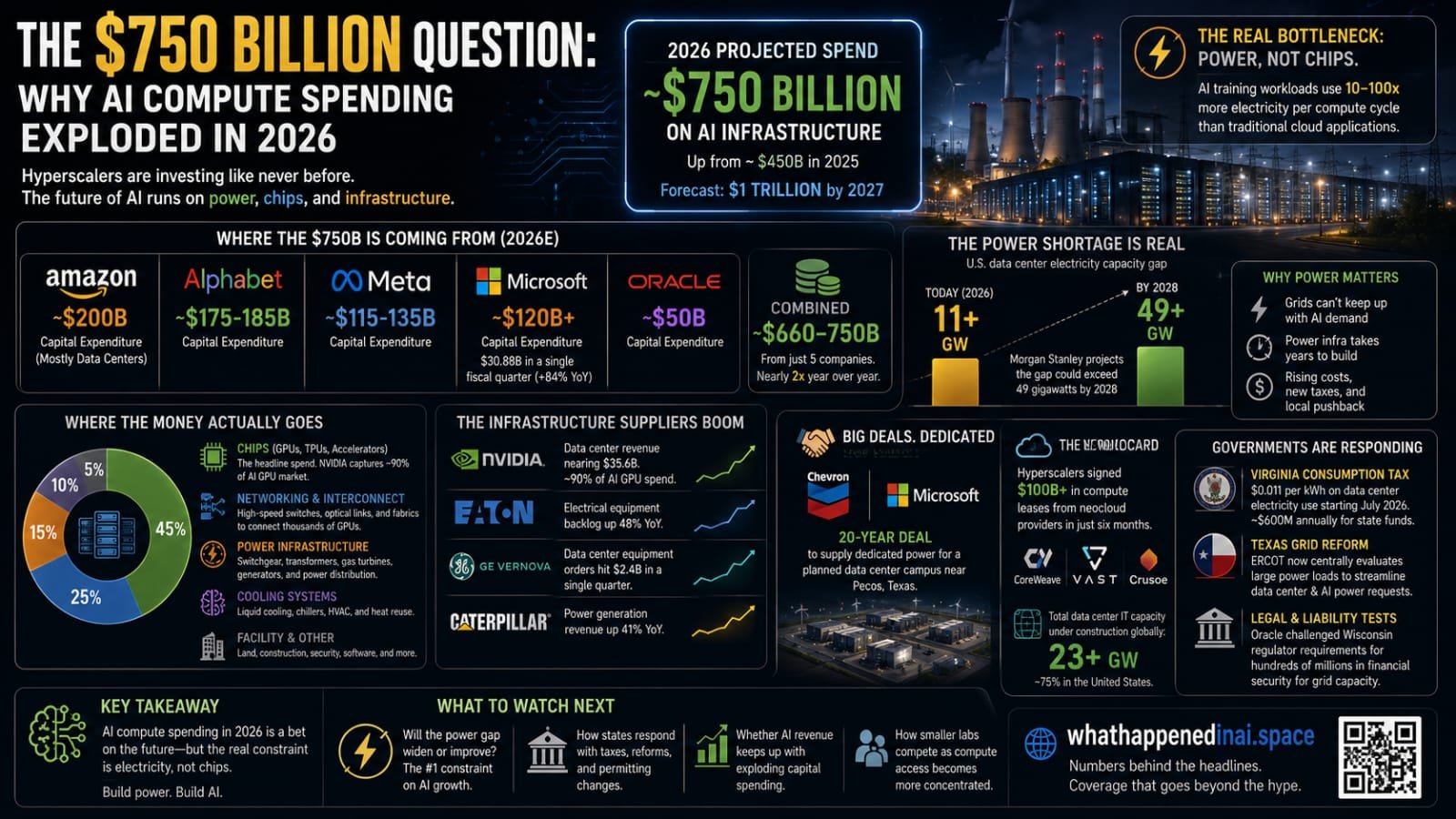
Somewhere between the model launches and the policy headlines, there’s a number that dwarfs almost everything else happening in AI this year: roughly $750 billion. That’s the amount the largest hyperscalers — Microsoft, Amazon, Alphabet, Meta, and Oracle — are collectively projected to spend on AI infrastructure in 2026 alone, up from around $450 billion just the year before. Some estimates place the combined figure even higher once additional players are included, and forecasts already point toward the trillion-dollar mark by 2027.
To put that in perspective, this combined annual spending commitment from just five companies exceeds the entire GDP of all but roughly the top twenty national economies in the world. This isn’t incremental investment representing gradual capacity expansion. It’s an industry-wide bet that AI will fundamentally restructure computing, business operations, and economic growth — and it’s worth understanding exactly where that money is actually going, because the answer is more interesting than “buying more chips.”
The Headline Numbers, Company by Company
Breaking down the roughly $700-750 billion figure by company gives a clearer sense of scale. Amazon has projected approximately $200 billion in capital expenditure for 2026, most though not all of it directed at data centers. Alphabet has guided toward $175-185 billion. Meta is targeting $115-135 billion. Microsoft is tracking toward $120 billion or more for the calendar year, with some quarterly figures suggesting the final number could land even higher — the company spent $30.88 billion in a single fiscal quarter alone, an 84% year-over-year increase. Oracle, smaller than the other four but growing its AI infrastructure ambitions fast, is targeting around $50 billion.
Combined, these five companies alone plan to spend somewhere in the range of $660-750 billion on infrastructure in 2026, the vast majority of it directed at AI compute, data centers, and networking rather than traditional cloud infrastructure. That represents a near-doubling of aggregate annual spending in a single year, and every one of these companies has told investors their markets are supply-constrained rather than demand-constrained — meaning they could sell more AI compute capacity than they currently have, if only they could build it fast enough.
Where the Money Actually Goes
It’s tempting to assume this entire figure is simply “buying GPUs,” and chips are certainly a massive piece of it — NVIDIA’s data center revenue alone has approached $35.6 billion in recent quarters, and the company is estimated to capture something like 90% of AI GPU spending industry-wide. But that framing badly undersells how much of this capital is going toward the physical infrastructure required to actually power and cool that hardware.
NVIDIA’s own networking revenue increased 162% in a recent quarter, reflecting the sophisticated interconnect equipment needed to coordinate thousands of GPUs working together in parallel during model training. Beyond networking, an enormous and growing share of this capital is flowing into power infrastructure specifically: switchgear, transformers, gas turbines, and prime-power generators, the unglamorous hardware that turns electricity into usable compute capacity. Eaton’s electrical equipment backlog jumped 48% year-over-year on the back of this demand. GE Vernova’s data-center equipment orders hit $2.4 billion in a single quarter, already surpassing its entire prior-year total. Caterpillar’s power generation revenue rose 41% year-over-year for the same reason.
This shift matters because it tells you where the actual bottleneck has moved. A year or two ago, the binding constraint on AI buildout was chip availability — could you get enough GPUs. In 2026, the binding constraint has shifted decisively toward power. AI training workloads consume somewhere between 10 and 100 times more electricity per compute cycle than traditional cloud applications, and the grid infrastructure needed to supply that power at scale simply hasn’t kept pace with demand.
The Power Shortage Is the Real Story
This is arguably the most underappreciated thread in the entire AI infrastructure boom. Goldman Sachs has documented that US data centers already face a capacity shortfall exceeding 11 gigawatts today, and Morgan Stanley projects that cumulative gap could exceed 49 gigawatts by 2028 if current trends continue. That’s not a chip shortage. That’s an energy shortage, and it’s a fundamentally harder problem to solve quickly, because building new power generation and transmission infrastructure operates on a much slower timeline than manufacturing semiconductors.
This has led to some genuinely novel deals. Chevron and Microsoft signed a 20-year agreement to supply dedicated power for a planned data center campus near Pecos, Texas — one of the largest pairings of compute infrastructure with on-site power generation in the US. Rather than simply drawing from the existing grid, hyperscalers are increasingly securing dedicated, long-term power supply arrangements directly with energy companies, effectively building parallel power infrastructure alongside their compute infrastructure. Microsoft’s Wisconsin campus, a $3.3 billion facility that recently came fully online, is another example of the sheer scale these individual projects now represent.
State and local governments are adjusting policy in response, not always in ways the industry welcomes. Virginia approved a first-of-its-kind consumption tax on data center electricity use, set at $0.011 per kilowatt-hour beginning July 2026, projected to generate roughly $600 million annually for the state’s general fund. Texas overhauled its evaluation process for large power loads, replacing a fragmented utility-by-utility approach with a centralized system run through ERCOT, specifically because of the sheer volume of data center and AI-related power requests flooding in. These aren’t abstract policy debates — they’re direct responses to hyperscalers’ infrastructure ambitions physically straining regional power grids.
Is This Spending Justified by Revenue?
The obvious question hanging over a $750 billion annual commitment is whether the revenue is actually there to justify it, or whether this is a speculative bubble waiting to deflate. The honest answer is: it’s genuinely too early to say with confidence, and reasonable, well-informed people disagree.
On the optimistic side, OpenAI reportedly ended 2025 with approximately $20 billion in annual recurring revenue, roughly triple the prior year’s figure, suggesting real demand growth underneath the infrastructure buildout rather than pure speculation. Cloud divisions across the major hyperscalers have also reported strong growth tied specifically to AI workloads, with some segments posting revenue growth in the 28-63% range year-over-year. NVIDIA’s CEO has publicly stated he expects the current AI data center spending cycle to continue for seven to eight more years, calling it a “once-in-a-generation” opportunity — though it’s worth remembering that statement comes from the company benefiting most directly from continued spending.
On the more cautious side, financial commentators have noted that both Alphabet and Tesla have tested Wall Street’s patience this year as AI spending increasingly overshadows near-term growth and profitability metrics, and some quarterly earnings reports have shown stock price reactions that suggest investor nervousness about the pace of capital commitment relative to demonstrated returns. The core tension is straightforward: this spending is happening years ahead of certainty about exactly how large and how profitable the eventual AI-driven revenue streams will be, which is either visionary infrastructure investment or risky overbuilding, depending on how the next few years play out.
What This Means for the Broader AI Industry
This spending boom has ripple effects well beyond the five companies writing the checks. It shapes which AI labs can access the compute needed to train frontier models in the first place — a meaningful advantage for companies with hyperscaler backing or direct infrastructure partnerships, and a real disadvantage for smaller, independent labs trying to compete on model quality without comparable compute access. It’s part of why open-weight models and smaller, more efficient architectures have become an increasingly important counter-trend this year: not every promising AI approach requires access to a $700 billion infrastructure buildout to be competitive.
It also explains a lot of the urgency behind release timelines discussed elsewhere in AI coverage this year. When a company has committed tens of billions of dollars to infrastructure specifically built for training and running next-generation models, there’s enormous internal pressure to ship those models on schedule and start generating revenue against that capital commitment — which may partly explain why so many major labs have been racing to release updated models in rapid succession throughout 2026, sometimes ahead of what earlier, more cautious release cycles might have looked like.
The Neocloud Wildcard
There’s a lesser-known thread in this story worth understanding: neoclouds, the newer wave of specialized compute providers that lease AI training and inference capacity to companies that don’t want to build their own data centers from scratch. Over a six-month period tracked by BloombergNEF, hyperscalers signed leases for compute capacity from these neocloud providers worth, in aggregate, in excess of $100 billion. That’s a meaningful signal in its own right: even companies with hundreds of billions of dollars in their own capex budgets are still choosing to lease additional capacity from third parties rather than build everything themselves.
This matters for a couple of reasons. First, it suggests that even the largest hyperscalers see genuine value in diversifying where their compute comes from, rather than betting entirely on their own build-out timelines, which can slip due to permitting delays, equipment shortages, or power availability. Second, it’s created an entirely new category of AI infrastructure company — one whose main product isn’t a model or a consumer app, but raw compute capacity itself, sold much like a commodity. Total data center IT capacity under construction globally topped 23 gigawatts as of recent tracking, with roughly three-quarters of that concentrated in the United States, illustrating just how much of this parallel build-out is happening simultaneously across both hyperscaler-owned and third-party neocloud facilities.
Legal and Regulatory Friction Around the Buildout
The scale of this spending hasn’t gone unchallenged. In Wisconsin, Oracle asked a state court to overturn a decision by utility regulators requiring some hyperscale data center developers to post hundreds of millions of dollars in financial security before proceeding — an early legal test of how individual states will allocate the risk associated with committing scarce grid capacity to a single company’s data center project. If a company builds a facility and then scales back or exits, who bears the cost of the power infrastructure that was built to serve it? Regulators in several states are actively working through exactly that question right now, and the outcomes will likely shape how future data center projects get financed and approved nationwide.
This kind of friction is likely to increase, not decrease, as more communities grapple with the tradeoffs between the economic benefits of hosting a hyperscale data center — jobs, tax revenue, infrastructure investment — against the costs, including strained local power grids, rising regional electricity prices, and the sheer physical footprint these facilities require. Arizona’s Prime Data Centers recently opened the first facility in a 240-megawatt hyperscale campus on just 66.5 acres, a useful illustration of how much power a relatively modest-looking site can actually demand once it’s built out to full capacity.
What to Watch Next
A few threads worth tracking as this story develops over the rest of the year:
- Whether the power shortage gets meaningfully worse or better. The gap between projected AI power demand and available grid capacity is currently the single biggest physical constraint on the entire industry’s growth trajectory, more binding than chip supply at this point.
- How state and local governments respond to strained power grids and rising local electricity costs, since data-center-specific taxes and utility overhauls like Virginia’s and Texas’s are likely to spread to other states facing similar pressure.
- Whether hyperscaler revenue growth from AI products keeps pace with capital spending growth. If the gap between spending and demonstrated returns widens further, expect increasing investor scrutiny and potentially slower capex guidance in future earnings calls.
- How smaller AI labs and open-weight projects navigate a market where compute access is increasingly concentrated among a handful of companies with the capital to build at this scale.
The Bigger Picture
The AI story that gets the most headlines is usually about what a new model can do. But underneath every model release this year sits an enormous, largely invisible infrastructure buildout — one that’s reshaping power grids, state tax policy, and global capital markets in ways that will likely outlast any individual model generation. Whether this $750 billion bet pays off in the way its backers expect is one of the genuinely open questions in the entire AI industry right now, and it’s one worth watching just as closely as the next chatbot release.
Frequently Asked Questions
How much are hyperscalers spending on AI infrastructure in 2026?
Estimates from multiple analysts place combined spending from the five largest hyperscalers — Microsoft, Amazon, Alphabet, Meta, and Oracle — at roughly $700-750 billion for 2026, up from around $450 billion in 2025.
What is the biggest bottleneck in AI infrastructure right now?
Power, not chips. US data centers already face an electricity capacity shortfall exceeding 11 gigawatts, with projections suggesting that gap could exceed 49 gigawatts by 2028.
Is AI infrastructure spending actually generating revenue?
It’s mixed. Some companies, like OpenAI, have reported strong recurring revenue growth, and cloud divisions tied to AI workloads are growing quickly. But investors have shown increasing nervousness about whether near-term revenue justifies the scale of capital commitment.
Why are hyperscalers signing direct power deals with energy companies?
Because grid capacity hasn’t kept pace with AI power demand. Deals like Microsoft’s 20-year agreement with Chevron for a Texas data center campus let companies secure dedicated power supply rather than relying solely on the existing, increasingly strained grid.


Leave a Reply