

Meta Description: 2026 is the year AI regulation stopped being theoretical. From China’s AI companion law forcing agent shutdowns to the EU ordering Google to open Android, here’s what’s actually changing and why it matters.
Focus Keyword: AI regulation 2026
Secondary Keywords: China AI companion law, EU Digital Markets Act AI, AI agent shutdown, Google Android AI ruling, AI safety commitments
AI Regulation Just Got Real: What China’s Agent Shutdown Law and the EU’s Android Ruling Mean for You
For the last few years, “AI regulation” has mostly meant white papers, proposed frameworks, and politicians promising something would happen eventually. July 2026 is the month that stopped being true. Two separate stories broke within weeks of each other, on opposite sides of the world, and together they show that governments are no longer just talking about AI oversight — they’re actively reshaping how these systems can operate, who profits from them, and who gets access to the infrastructure underneath them.
This article walks through both stories in detail, explains why they’re connected even though they look unrelated on the surface, and lays out what it actually means if you build, invest in, or simply use AI products.
China’s AI Companion Law Is Forcing Real Shutdowns
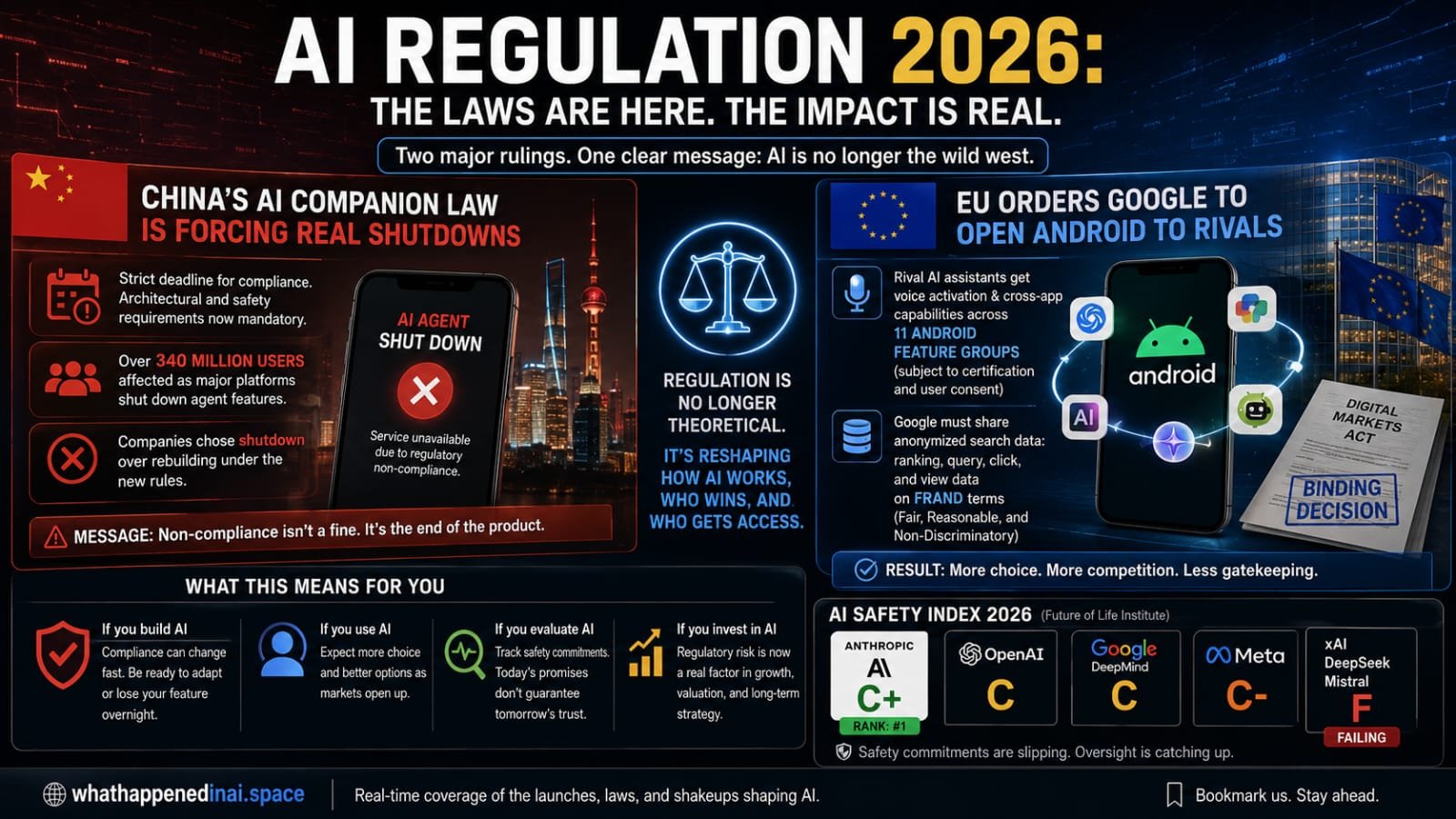
The bigger of the two stories involves China’s new AI companion regulation, which gave companies a strict countdown to bring their AI agent products into compliance. When the deadline hit, in the days leading up to it, it didn’t just mean fines or warnings for companies that weren’t ready. Companies had to make a real, binary choice: rebuild their agent features under the new compliance architecture in time, or shut them down entirely.
Multiple major platforms chose to shut agent features down completely rather than rebuild under the new rules — including products serving over 340 million users on apps like Doubao. Think about the scale of that for a second. This isn’t a niche AI startup pulling a beta feature nobody noticed. This is hundreds of millions of active users losing access to AI agent functionality overnight because the compliance cost of keeping it running, under the new architecture the regulation required, was judged higher than the cost of simply turning it off.
That’s a meaningful data point for anyone who assumed AI regulation would just mean companies quietly adjusting their terms of service and moving on. In China’s case, it meant some companies deciding certain AI features simply weren’t worth keeping alive under the new legal framework, at least not on the current timeline. It’s a genuinely rare example of regulation producing an immediate, visible, mass-scale product change rather than a slow, barely noticeable drift in behavior.
What Was Actually in the Compliance Architecture
While the specific technical requirements companies had to meet varied by product, the broad thrust of China’s approach has centered on tighter controls over AI companion and agent products specifically — the category of AI that interacts with users in ongoing, personalized, relationship-like ways, or that can take autonomous actions on a user’s behalf. That’s a notably different regulatory target than general-purpose chatbots or productivity tools. Regulators appear to be treating “AI that forms an ongoing relationship with a user” and “AI that can act autonomously” as categories that carry distinct risks worth their own dedicated compliance rules, rather than lumping all AI products under one blanket policy.
For companies operating in China’s market, the message is clear: the cost of non-compliance isn’t hypothetical anymore, and the timelines for meeting new requirements can be short enough that “we’ll get to it eventually” is no longer a viable strategy.
The EU Just Forced Google to Open Up Android
On the other side of the world, the European Commission adopted binding requirements under the Digital Markets Act ordering Google to open Android to rival AI assistants and share portions of its search data with competing developers. This isn’t a slap on the wrist either, and it isn’t a proposal still working through committee — it’s a binding decision with real compliance deadlines attached.
Under the ruling, eligible third-party AI assistants gain voice activation and cross-app capabilities across eleven separate Android feature groups, subject to certification and user consent. Google is also required to make anonymized ranking, query, click, and view data available to competitors on fair, reasonable, and nondiscriminatory terms. In plain English: rival AI assistants can now plug into Android in ways that used to be exclusive to Google’s own products, and they get a meaningful head start by tapping into data Google previously kept entirely to itself.
This is a genuinely big deal for the AI assistant market, and it’s worth sitting with why. Being the default, deeply embedded assistant on the world’s most-used mobile operating system has been one of Google’s biggest structural advantages — arguably as valuable as any individual model capability, because distribution at that scale is nearly impossible for a competitor to replicate through product quality alone. The EU just legislated a crack in that advantage, and it did so through competition law rather than AI-specific legislation, which is itself an interesting regulatory strategy: using existing market-fairness tools to shape AI competition rather than waiting for AI-specific rules to catch up.
Why Eleven Feature Groups Matters More Than It Sounds
The detail about eleven distinct Android feature groups is easy to skim past, but it’s actually the part that determines how meaningful this ruling is in practice. A ruling that simply said “let rival assistants exist on Android” without specifying what capabilities they get access to could have been complied with in a token, minimally useful way. Specifying voice activation and cross-app capabilities across defined feature categories, subject to certification, gives the ruling actual teeth — it’s harder for Google to comply with the letter of the ruling while keeping the practical experience for rival assistants degraded or clunky compared to Google’s own.
Why Both Stories Are Really the Same Story
China and the EU took very different regulatory approaches — one focused on user safety and product compliance for AI companions, the other on market competition and platform openness — but they point to the same underlying shift. Regulators in 2026 aren’t waiting for AI companies to self-police anymore, and they’re willing to force outcomes that directly hit user experience and company revenue, not just paperwork sitting in a compliance department’s filing cabinet.
That lines up with a broader trend flagged by independent safety researchers this year: the Future of Life Institute’s latest AI Safety Index found that several major AI labs have been quietly weakening or removing their own voluntary safety commitments, including pledges to pause development as systems approach specific risk thresholds. Anthropic ranked first among major labs in that review but still only received a C+ grade, with OpenAI and Google DeepMind receiving straight C grades. Meta showed improvement, while xAI, DeepSeek, and Mistral received failing grades entirely.
When companies loosen their own guardrails at the same time regulators are watching more closely, it tends to accelerate exactly this kind of government intervention. Regulators don’t love being told to trust a voluntary promise that’s already being walked back in practice, and both the China and EU actions this month can reasonably be read as governments deciding that voluntary commitments alone aren’t a sufficient basis for oversight anymore.
What This Means If You Build or Use AI Products
A few practical takeaways worth sitting with, depending on where you sit in the AI ecosystem:
- If you build on AI agent platforms, assume the compliance ground can shift fast, and sometimes the “fix” a company chooses is simply removing the feature rather than rebuilding it under new rules. Building in flexibility for features to be modified or pulled on short notice, particularly in tightly regulated markets, is no longer a purely theoretical risk-management exercise.
- If you rely on an AI assistant embedded in a platform like Android, expect more competition and more genuine choice showing up in places that used to be locked down by default. That’s likely to mean more assistant options appearing in the coming months, though how quickly rivals actually take advantage of the new access will depend on their own product readiness.
- If you’re evaluating which AI company to trust with your data or workflow, safety-commitment tracking — like the Future of Life Institute’s AI Safety Index — is becoming a genuinely useful signal, not just an advocacy exercise. A company’s grade on these evaluations increasingly correlates with how exposed it might be to future regulatory action.
- If you’re an investor or executive assessing AI exposure, both of these stories are reminders that regulatory risk in this sector is no longer a distant, hypothetical line item. It’s already shown up as a mass product shutdown affecting hundreds of millions of users and a binding order restructuring how a trillion-dollar company operates its core platform.
How This Compares to Earlier AI Regulation Attempts
Earlier rounds of AI regulation discussion — going back a couple of years — tended to focus heavily on disclosure requirements, watermarking AI-generated content, and voluntary safety testing frameworks. Those approaches share a common thread: they mostly asked companies to be more transparent rather than forcing structural changes to how products actually function or who gets access to underlying infrastructure.
What’s different about July 2026’s developments is the shift from “tell us more” to “change how this actually works.” China didn’t ask companies to disclose more about their AI companion products; it required specific architectural compliance with a hard deadline. The EU didn’t ask Google to publish more information about how Android favors its own assistant; it ordered structural access changes with defined technical specifications. That’s a meaningfully more assertive regulatory posture than what the industry has generally experienced up to this point, and it suggests regulators globally are becoming more comfortable moving from soft-touch guidance to binding structural intervention.
What Happens Next in Both Regions
Neither of these stories is fully resolved, and both are worth watching closely over the coming months. In China, the immediate question is whether companies that shut down agent features will attempt to relaunch them under the new compliance architecture, or whether some will decide the category simply isn’t worth re-entering given the ongoing regulatory burden. If major platforms do rebuild and relaunch compliant versions, it will offer a real-world template for what “AI companion regulation done right” looks like from an implementation standpoint — something other regulators worldwide are likely to study closely given how few precedents currently exist at this scale.
In the EU, the practical rollout will hinge on certification processes for third-party assistants and how quickly rivals can actually build features that take advantage of the new access. A binding legal order is one thing; a genuinely competitive alternative assistant experience on Android is another, and building that takes real engineering time even once the legal pathway is open. Watch for which companies move fastest to certify and ship — that will tell you a lot about who was already prepared for this outcome versus who’s scrambling to catch up now that the door has opened.
There’s also likely to be a ripple effect beyond the two specific companies involved. Other jurisdictions weighing their own AI and platform regulation are watching both of these cases closely as test cases. If China’s compliance-or-shutdown approach proves manageable for the industry without excessive economic disruption, expect other governments considering AI companion rules to reference it directly. Similarly, if the EU’s Android ruling meaningfully increases competition in the AI assistant market without breaking core platform functionality, expect other regulators overseeing dominant tech platforms to pursue similar structural remedies rather than settling for disclosure-only requirements.
The Bigger Picture
For years, the running joke in AI circles was that regulation moves slower than the technology it’s trying to govern. That gap hasn’t closed completely, and plenty of jurisdictions are still stuck at the white-paper stage. But July 2026 is proof the gap is narrowing fast in at least some of the world’s largest markets. Between China’s willingness to force agent shutdowns at massive scale and the EU’s willingness to legislate open access to a trillion-dollar mobile ecosystem, governments have shown they’re prepared to act, not just propose.
The AI industry spent the first half of this decade optimizing almost entirely for capability — bigger models, better benchmarks, faster releases. The second half increasingly looks like it will be shaped just as much by what regulators allow that capability to actually do, who gets to access the platforms it runs on, and how much trust companies have left to draw on after a year of loosened voluntary commitments.
Frequently Asked Questions
What is China’s AI companion law?
It’s a regulation that set a compliance deadline for AI companion and agent products operating in China, requiring companies to meet new architectural and safety requirements or shut the relevant features down.
How many users were affected by the AI agent shutdowns in China?
Reports indicate platforms serving over 340 million users, including apps like Doubao, shut down agent features entirely rather than rebuild them under the new compliance rules.
What did the EU order Google to do?
Under the Digital Markets Act, the European Commission ordered Google to open Android to rival AI assistants across eleven feature groups and share anonymized search data with competitors on fair, reasonable, and nondiscriminatory terms.
Which AI companies scored best on safety commitments in 2026?
According to the Future of Life Institute’s AI Safety Index, Anthropic ranked highest among major labs, though still only earning a C+, followed by C grades for OpenAI and Google DeepMind.


Leave a Reply