
Meta Description: Tesla robotaxis are now operating with no safety monitor across six US cities and 380,000+ unsupervised miles. Here’s what the milestone means for autonomous AI, regulation, and public trust in 2026.
Focus Keyword: Tesla Robotaxi no safety monitor
Secondary Keywords: driverless AI 2026, autonomous vehicles regulation, physical AI, Tesla FSD, self-driving car safety
Tesla’s Robotaxis Just Went Fully Driverless — Here’s What That Actually Means for AI in the Real World
Most AI news in 2026 has lived on a screen: chatbots, coding assistants, agents that book your calendar. Tesla’s robotaxi program is a reminder that a huge chunk of the AI story is also happening on actual streets, with actual cars, carrying actual passengers, with no human anywhere nearby to grab the wheel if something goes wrong. That’s a very different kind of stakes than a chatbot giving a wrong answer, and it’s why the robotaxi milestone Tesla hit this month deserves more attention than it’s getting outside of EV and transportation circles.
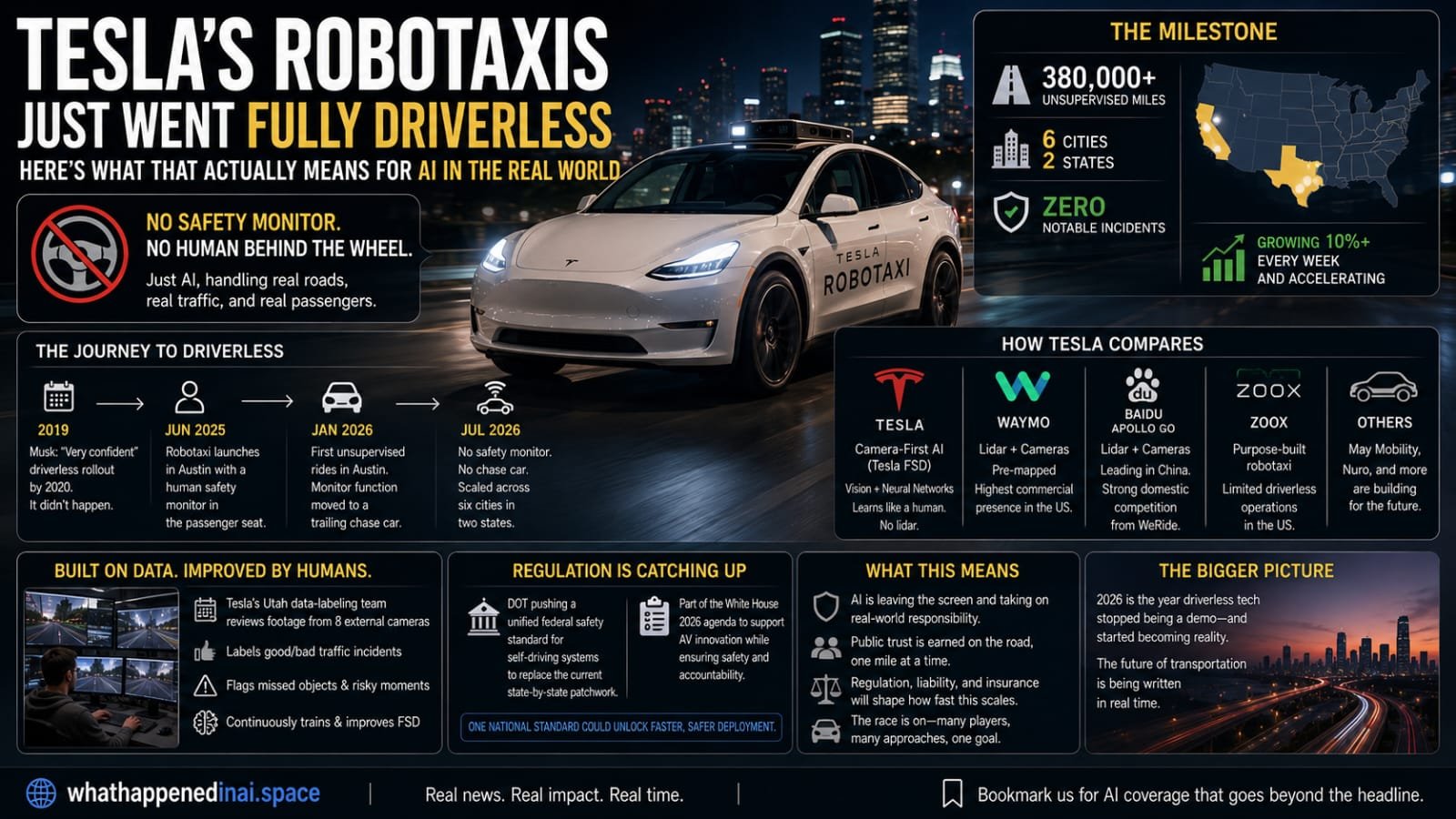
As of late July 2026, Tesla says its Robotaxi program has driven more than 380,000 unsupervised miles across six cities in two states, with what the company describes as an impeccable safety record and zero notable incidents. That’s a genuinely significant number, and it’s worth understanding both what it proves and what it doesn’t.
How Tesla Got Here
The path to this point was slower and messier than Elon Musk’s public statements over the years would suggest. Musk told investors back in 2019 he was “very confident” driverless rollout would happen by 2020. It didn’t. Robotaxi rides finally launched in Austin in June 2025, but every vehicle had a human safety monitor in the passenger seat, ready to intervene. A San Francisco Bay Area service followed with a human still behind the wheel.
The real shift started in January 2026, when Musk posted that Tesla had begun running a small number of Robotaxi vehicles in Austin with no safety monitor inside the car at all — though for a period, that monitor’s function was effectively moved to a trailing chase car with a remote operator watching. Tesla’s own VP of AI software described the early phase plainly: a few unsupervised vehicles mixed into the broader fleet, with the ratio of unsupervised to supervised vehicles increasing gradually over time rather than flipping a switch overnight.
That gradual, ratio-based rollout is a meaningfully different approach than Musk’s earlier public promises, which tended toward big, immediate numbers — “500 Robotaxis by the end of the year,” “autonomous ride hailing in probably half the population of the U.S.” Those specific targets mostly didn’t materialize on schedule. What did happen was a slower, more methodical expansion that, by July, had racked up a genuinely large mileage total without a major public incident.
The Numbers That Actually Matter
380,000 unsupervised miles across six cities in two states, with zero notable incidents reported, is the headline figure Tesla is leaning on. Musk has said the network is growing more than 10% a week in terms of miles driven, which suggests the company is now confident enough in the underlying system to accelerate rather than continue the cautious, incremental approach that defined the first half of the year.
It’s worth being careful about how to read a safety statistic like this, though. Zero notable incidents over 380,000 miles sounds impressive, and it is a meaningful data point, but it’s also a self-reported figure from the company with the most to gain from a positive narrative, covering a relatively short and geographically limited test period compared to the billions of miles humans drive every single day in the US. A fair comparison requires much larger datasets and independent verification over time, not just an early company-reported milestone, however encouraging that milestone might be.
Where Tesla Actually Stands Compared to Competitors
It’s a common misconception that Tesla is leading the driverless race simply because Musk talks about it constantly. The reality on the ground is more complicated. Alphabet’s Waymo currently leads the US market for commercial robotaxi services operating with no drivers or safety monitors present at all, and has for some time. Baidu’s Apollo Go holds a similar leading position in China, facing serious competition from WeRide. Amazon’s Zoox has begun limited driverless operations in the US as well, and smaller players like May Mobility and Nuro are developing their own offerings in parallel.
What makes Tesla’s approach distinct isn’t that it was first — it clearly wasn’t — but the underlying technology stack it’s betting on. Unlike Waymo, which relies heavily on lidar and detailed pre-mapped routes, Tesla’s Full Self-Driving software is built primarily around cameras and neural networks trained to interpret the world visually, closer to how a human driver processes the road. That’s a genuinely different technical bet, and it’s one that’s been controversial among autonomous vehicle researchers for years, with critics arguing camera-only systems lack the redundancy that lidar provides in poor visibility or unusual edge cases.
Reuters reporting on Tesla’s data-labeling operation offers a useful window into how the system actually gets trained: hundreds of employees in a Utah office review footage from the eight external cameras on each vehicle, labeling traffic incidents as good or bad, identifying objects the system fails to recognize, and flagging spots where the technology still needs improvement. That’s a labor-intensive, ongoing process — a reminder that “AI driving itself” still depends on a large amount of continuous human oversight happening behind the scenes, even as the on-road supervision disappears.
The Regulatory Backdrop Is Shifting Fast
Tesla’s rollout hasn’t happened in a regulatory vacuum, and the political dimension of this story is arguably as important as the technical one. Federal safety regulators have previously pushed Tesla for detailed explanations of how it would keep riders safe with its camera-only approach before the Austin launch even began. That kind of scrutiny is normal and expected for a genuinely new category of consumer transportation.
What’s changed more recently is the direction of federal policy. The Department of Transportation has been pushing to create a unified federal safety standard for self-driving systems, aiming to replace the current patchwork approach where individual states and cities each decide independently whether autonomous systems are safe enough to operate on their public streets. That push toward a national framework was included in the White House’s 2026 regulatory agenda, alongside proposals to loosen certain vehicle safety requirements specifically to accommodate autonomous vehicles like Tesla’s planned Cybercab.
This matters enormously for the pace of robotaxi expansion generally, not just for Tesla. A fragmented, state-by-state approval process has historically been one of the biggest bottlenecks slowing driverless rollout across the industry — a company can achieve regulatory approval in one city and still face a completely separate approval process in the next one over. A unified federal standard, if it materializes, could meaningfully accelerate deployment timelines across every company in this space, not just Tesla, while also concentrating both the benefits and the risks of that faster pace into a single national framework rather than distributed local decision-making.
What This Means for Public Trust in Autonomous AI
Every driverless vehicle on public roads is also, in a very real sense, a public trust experiment for AI more broadly. Unlike a chatbot mistake, which might produce an awkward or wrong answer that a person can simply ignore, a mistake in a two-ton vehicle moving through an intersection has a completely different order of consequence attached to it. That’s exactly why this category of AI deployment tends to move more cautiously than software-only AI products, and why a single high-profile incident can set an entire industry’s public perception back years, regardless of how strong the underlying statistics are.
Tesla’s specific approach — starting with a small ratio of unsupervised vehicles and gradually increasing that ratio as confidence builds, rather than flipping the entire fleet driverless at once — reflects an awareness of that dynamic, whether it was chosen purely for safety or, more cynically, purely for optics and gradual risk management. Either way, the incremental rollout strategy has so far avoided the kind of dramatic public incident that could derail momentum, which itself is meaningful given the company’s history of ambitious, sometimes unmet, public promises.
Why Camera-Only Systems Remain Controversial
It’s worth spending a bit more time on the technical debate underneath this story, because it shapes how seriously to take any safety milestone Tesla announces. The core disagreement in the autonomous vehicle research community centers on sensor redundancy. Lidar-based systems, like the ones Waymo relies on, build a real-time 3D map of the environment using laser pulses that work reliably regardless of lighting conditions. Camera-only systems, like Tesla’s, depend on visual interpretation similar to human vision, which means they can, in theory, be affected by the same conditions that challenge human drivers: glare, heavy rain, fog, or unusual lighting at dusk and dawn.
Tesla’s argument, repeated by Musk and company engineers for years, is that humans drive successfully using vision alone, so a sufficiently advanced neural network should be able to do the same, without the cost and complexity of maintaining a separate lidar sensor suite. Critics counter that human vision is paired with an enormously sophisticated, evolved brain capable of handling ambiguity and edge cases in ways current neural networks still struggle to replicate reliably, and that removing a redundant sensing modality removes a valuable safety margin, not just a cost center. This debate isn’t resolved, and it probably won’t be resolved by press releases from either side — it will be resolved, eventually, by large-scale, independently verified safety data collected over millions or billions of miles, which is exactly the kind of dataset Tesla’s current program hasn’t yet accumulated.
The Insurance and Liability Question Nobody’s Fully Answered
One thread that gets relatively little mainstream coverage but matters enormously for how fast this technology actually scales is liability. When a human driver causes an accident, the insurance and legal framework for assigning fault is well established, even if it’s not always fast or pleasant to navigate. When a fully autonomous vehicle with no human occupant behind the wheel is involved in an incident, the question of who bears responsibility — the vehicle manufacturer, the software provider (which may or may not be the same company), the fleet operator, or some combination — is still being actively worked out across different jurisdictions.
This isn’t a minor footnote. Insurance markets need clear, predictable liability frameworks to price risk accurately, and until those frameworks mature and stabilize across more states, insurers may remain cautious about underwriting large-scale driverless fleets at the pace companies like Tesla would prefer. A unified federal standard, if it addresses liability clearly alongside safety requirements, could meaningfully unlock faster scaling. If it leaves liability ambiguous, expect continued friction regardless of how good the underlying safety statistics look.
What Riders Are Actually Experiencing
Beyond the statistics and the regulatory maneuvering, it’s worth remembering that real people are stepping into these vehicles every day, in a small number of American cities, and simply going about their commutes or errands. Early rider accounts from Austin and the Bay Area have generally described the experience as smooth, if occasionally cautious to the point of feeling overly conservative at intersections or during unprotected turns — a common trait among autonomous systems trained to prioritize safety margins over driving assertively. That kind of consumer feedback, aggregated over enough rides, becomes its own dataset that shapes future software updates, separate from the formal safety-incident tracking Tesla highlights in earnings calls.
What to Watch Next
A few threads worth following as this story develops further:
- Whether the 10%-weekly mileage growth rate holds. Scaling from a small number of unsupervised vehicles to a genuinely large fleet is a different challenge than proving the concept works at small scale, and growth rates like this often slow as edge cases accumulate.
- How independent regulators and researchers evaluate Tesla’s safety data, rather than relying solely on company-reported statistics, which is a meaningful gap in the current public conversation around this milestone.
- Whether the proposed federal self-driving standard actually materializes, and what specific safety requirements it ultimately contains, since the details of any national framework will shape how fast every company in this space — not just Tesla — can expand.
- How competitors respond. Waymo, Zoox, and international players like Baidu’s Apollo Go aren’t standing still, and the driverless race is very much still open despite Tesla’s headline-grabbing announcements this year.
The Bigger Picture
The robotaxi story is a useful reminder that “AI progress” isn’t just a story about chatbots getting smarter or coding agents getting more reliable. It’s also, increasingly, a story about AI systems taking on physical-world responsibilities that used to require a human’s full attention and judgment behind the wheel. That transition brings a different category of risk, a different category of regulation, and — as this year has shown — a genuinely different pace of public scrutiny than the software-only side of the AI industry has faced so far.
Whether Tesla’s specific approach proves to be the right one long-term is still an open question. What’s not in question is that 2026 is the year driverless technology stopped being a demo and started being a real, if still limited, part of how people get around several American cities.
Frequently Asked Questions
Is Tesla’s Robotaxi fully driverless now?
A portion of Tesla’s Robotaxi fleet operates with no safety monitor inside the vehicle, across six cities in two states as of late July 2026, though the company has not confirmed a full fleet-wide transition away from supervised vehicles.
How many unsupervised miles has Tesla’s Robotaxi driven?
Tesla reported more than 380,000 unsupervised miles as of late July 2026, with the company describing zero notable incidents over that distance.
Is Tesla ahead of Waymo in driverless technology?
No. Waymo currently leads the US commercial robotaxi market for vehicles operating with no driver or safety monitor present, with Tesla still expanding its unsupervised fleet more gradually.
What federal regulations affect Tesla’s Robotaxi rollout?
The Department of Transportation has proposed a unified federal safety standard for self-driving systems, aiming to replace the current state-by-state approval process, as part of the White House’s 2026 regulatory agenda.


Leave a Reply